| Home | Our Hope | |
| Bible Study |
|
December 5, 2025 |
| The Star of Bethlehem | ||

There have been some silly ideas about what the star of Bethlehem was. Some have said it was a star that went nova. Others have claimed it was a comet and even identified the comet from ancient records and thereby divined the year that the star of Bethlehem appeared. There have been other ideas. As we will see in this study, none of these can be true.
The Bible provides the information we need to know to figure out what it was … or at least what it wasn't. We only need to listen.
In the time of Jesus, science wasn't as specialized as it is today. For example, Astronomy and Astrology were equally legitimate and part of the same field of research. It would be 1500 years before the two would split. Astronomy, the study of astronomical objects, would remain legitimate, but Astrology, the use of astronomical objects to predict the future, would become illegitimate.
At the time of Jesus, there was very little understanding of the night sky. Every bright object in the sky was a "star". What we now call planets and comets were also considered to be stars. Even today, we retain some of that in our language. For example, we say "shooting stars" or "falling stars," but those aren't stars. They are comets. The "morning star" and "evening star" are planets.
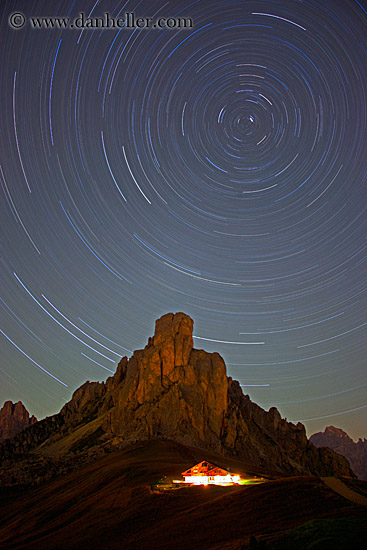
Understanding this lesson will require an understanding of one aspect of Astronomy known to all sky watchers. The Earth rotates. The result of this rotation is the appearance, to viewers on the earth each night, that all the stars rise on the horizon, pass overhead, and go down on the other horizon.
This rotation makes for interesting pictures, as seen in the time-lapse picture here1, where we see the northern stars appearing to rotate around the north star. The stars don't move enough for us to see. In reality, it is the Earth's rotation that causes this.

The thing to understand is that it is impossible to use a star, planet, or comet as a guide to a location on the Earth. If you were to use a star as a guide, you would start the night heading toward one horizon and finish it heading for the other.
A star is never over one point on the Earth for more than a millisecond. The point on the Earth that is directly below a star is always moving because the Earth is rotating. For stars that are aligned with the equator, that point moves at 1,000 miles per hour. If you wanted to be directly below such a star, you would need to travel 1,000 miles per hour all night.
We also need to understand a little bit about the Magi. They were the scholars of their time. While they could have been kings, they were not necessarily kings, but certainly would have been wealthy men to have had the spare time to pursue sky watching.
The Magi were astrologers. They studied the sky to determine major events such as the births of great men or the coming of great events. This was a well-established practice in Persia and other countries to the east of Judea. "Many sources from this period report the skill of Magi in divination"2
From events in the night sky, the Magi would interpret events on Earth. But it would have been very unusual for them to travel. They would have known the problem with using stars as guides.
We'll be looking at Matthew's story of the birth of Jesus. We'll focus on selected verses from Matthew 2:1-23, those that have the details about the star.
1 Now when Yeshua was born in Bethlehem of Judaea, in the days of Herodus the King, the Magi came from the east to Jerusalem. 2 And they were saying, "Where is the king of the Judaeans who has been born"? We have seen his star in the East and we have come to worship him.
They have followed a "star" to Judea. How did they do that? How did they know they could do that when they set out? The answer is easy. They saw a star that didn't move in the night sky, as all the other stars did. The people in Judea wouldn't have noticed it. You would need to be a keen, persistent observer to see it.
They try to get to the point on the ground that is directly below the star. That leads them to Jerusalem, but the star is too high in the sky for them to pinpoint the exact location. Early in their trip, it would have been easy to see which direction to go, but when it is almost overhead, it becomes very difficult. They would have lain down with their backs on the ground and tried to look straight up to get a good vertical reference. When an object is a long way away, it is hard to judge when you are facing directly at it. The smallest error translates into miles on the ground.
They can be precise enough to know the star is above Jerusalem. So, they wander around Jerusalem asking the inhabitants where the king of the Jews (Judeans) was born. Perhaps they are expecting that the king would be born in the palace.
Some believe their question indicates that they knew of the prophecies of the Messiah, but this isn't necessarily so. The appearance of a new star would have been a sign to them that a king was born. With the sign hovering over Judea, they would have assumed it was the birth of a king of the Judeans.
3But Herodus the king heard and he was troubled and all Jerusalem with him. 4 And he gathered the Chief Priests and the Scribes together and was asking them, "Where would the Messiah be born?". 5 And they said, "In Bethlehem of Judaea", for thus it is written in the Prophets […]
King Herod immediately recognizes that the wisemen are talking about the Messiah. It needs to be understood here that there were many people expecting the Messiah at that time. They had counted off the years as described in Daniel and knew the time was near. They tell Herod where prophecy says the Messiah would be born.
7 And then Herodus secretly called the Magi and learned from them at what time the star had appeared to them. 8 And he sent them to Bethlehem and said to them, "Go inquire about the boy very carefully and when you find him, come show me, so that I also may go worship him."
Herod is not asking out of curiosity. Even if it means killing the Messiah, Herod is not about to give up his throne. He begins assembling the information needed to make a plan to deal with this problem. Because of the long time it would have taken for the Magi to prepare for and make the trip to Judea, he needs to know when the star appeared to get a better idea of the age of the child.
We don't know if the Magi saw through Herod's treachery. Being studied and also wealthy, and perhaps the sons of kings, or even kings themselves, they should have understood what it would mean to have a contender for the throne. But it is possible that "they have no reason to think that Herod is not as sincere as they are to find the newborn king"4. Perhaps their amazement at the star has overshadowed their thinking.
9 But when they heard from the King, they went, and behold, that star which they had seen in the east went before them, until it came and stood over where the boy was. 10 And when they saw the star, they rejoiced with a very great joy.
Notice what happens here. The star they had followed west toward Judea now turns south and leads the Magi to Bethlehem. Also, where they previously couldn't tell where in Jerusalem to go, the star now descends enough to lead them directly to a particular house in Bethlehem. Also, it reduces in brightness. What was bright enough to be seen from where the maji were would be blinding, if not lethal, when over a house.
The "star" is clearly not an astronomical body. It is traveling in Earth's atmosphere. There is nothing like this in nature. God has caused something to exist that does all of these things.
There is no other mention of the star. Perhaps it vanishes when the Magi go inside the house. We don't know.
11 On coming to the house, they saw the child with his mother Mary, and they bowed down and worshiped him. Then they opened their treasures and presented him with gifts of gold and of incense and of myrrh.
Why are the Maji doing this? Why these particular gifts? This would have been the only time they ever could have traveled to the birthplace of a future king. So, it's going to be special for them. But there are irregularities in the story. From the start, they seem to have understood it would be a king. There were many great people, not all of whom were kings. They have brought gifts appropriate for a king. They also seem to know he will be male. There were great queens at that time as well. People have wondered how they knew this.
There is one answer that is interesting. This information came from King David. There is no evidence in the Bible, but God could have instructed David to prepare gifts for the Messiah and to instruct and finance some stargazers to deliver the gifts when they see the sign.
12 And it was seen by them in a dream that they should not return to Herodus, and they went to their country by another road. […] 16 And Herodus, when he saw that he was mocked by the Magi, was greatly enraged, and he sent and killed all the boys of Bethlehem and of all of its borders, from two years old and under. 17 Then the thing was fulfilled which was spoken by Jeremiah the Prophet which says:
18 "In Ramtha was heard weeping and great lamentation,
Rachel weeping over her children, and she is unwilling to be comforted,
because they are not."
Herod ruled by force, and he was ruthless about it. "Other rulers also proved paranoid about astrologers (see MacMullen 1966:133; Kee 1980:71), and some had been ready to kill their own descendants to keep the throne (Herod. Hist. 1.107-10). But as many incidents during Herod's reign illustrate, he was more paranoid than most other rulers."5
"When Herod's young brother-in-law was becoming too popular, he had a "drowning accident" in what archaeology shows was a rather shallow pool; later, falsely accused officials were cudgeled to death on Herod's order (Jos. War 1.550-51). Wrongly suspecting two of his sons of plotting against him, he had them strangled (Jos. Ant. 16.394; War 1.550-51), and five days before his own death the dying Herod had a more treacherous, Absalom-like son executed (Ant. 17.187, 191; War 1.664-65). Thus many modern writers repeat the probably [false] story that Augustus [Caesar] remarked, "Better to be Herod's pig than his son" (Ramsay 1898:219-20)."6
Herod the Great died about 6 years later.
19But when Herodus the king died, the Angel of the Lord Yahweh appeared in a dream to Yoseph in Egypt. 20 And he said to him, "Arise, take the boy and his mother, and go to the land of Israel, for those who were seeking the boy's life have died."
15[…]. And [Jesus] was [in Egypt] until the death of Herodus, that the thing might be fulfilled that was spoken from the Lord Yahweh through the prophet which says, "From Egypt I have called my Son." (verse out of sequence in this study)
The star of Bethlehem was not any kind of astronomical body, not a star, planet, or comet. It was something with a unique appearance that God directed. It was in our atmosphere. It stopped and moved in different directions. It changed altitude and brightness.
These verses leave us with some questions though.
Where were the priests in all of this? Herod consulted with them to learn the birthplace of the Messiah. Why didn't they troop down to Bethlehem to meet the Messiah?
We see here that Jesus was missed by the priests but worshiped by the Gentiles at his birth. This was to be the pattern for the boy king's future ministry.
A theme here is God working out His plan despite the plans of those in power.
How many Magi were there? The Bible never says there were three. "We three kings […]" has become a traditional belief within the church.
Why are we told about the Maji? Why were they even used by God? Why did the star take them to Jerusalem first? There is no specific prophecy about them. It appears God's intent was to send the Magi to Jerusalem first, so that other prophecies would be fulfilled. Herod needs to know about the coming Messiah so he will:
1 http://www.danheller.com/images/FAQ/Tech/Stars/img7.html#img11
2 IVP New Testament Commentary - Matthew - First Star Trek
4 NIV Standard Lesson Commentary, Christ the Fulfillment, Unit 1, Lesson 4
5 IVP New Testament Commentary - Matthew - First Star Trek
6 IVP New Testament Commentary - Matthew - Persecuted Child